

By Sevda Tunaboylu (UB) and Alèxia Rué (UB)
Detention has increasingly been used as the main strategy across Europe to prevent foreign citizens from absconding while pending for deportation. Yet, this is a highly contested measure as it often implies breaching several human and migrant rights. In Spain, civil society has a long tradition of advocating for the closure of all pre-removal detention centres for foreigners, known locally as CIEs – Centro de Internamiento de Extranjeros. But is this a realistic possibility within Spain’s current politico-legal framework? Grounded the data gathered and analysis of the first two research stages of MORE, in this blog post, we argue that abolishing pre-removal detention is a viable option.
In the last two decades, return and readmission policies has increasingly taken prominence in the European Union’s approach to migration and asylum governance. The 2023 Pact on Migration and Asylum called for a recast of the 2008 Return Directive, in which detention was emphasized as an effective solution to prevent undocumented migrants from absconding. While the recast of Return Directive is still being debated in the European Parliament, following current discussions, it is likely that it would expand the current framework for pre-removal detention and put more migrant at risk of human rights violations and abuse. Proposals include increasing the minimum time for pre-removal detention, expanding the grounds for determining the risk of absconding and extending the arguments for detention, including broad reasons such as “illegal entry” and lack of financial resources, all of which may result in increased arbitrariness in the use of detention.
There are, however, less coercive preventive measures adopted across EU member states to prevent absconding during an deportation case. These include reporting obligations (e.g. reporting to the police or immigration authorities at regular intervals); residence requirements (e.g. residing at a particular address); obligation to surrender a passport or a travel document; release on bail (with or without sureties); electronic monitoring (e.g. tagging); guarantor requirements or release to a care worker or under a care plan. While these other measures are not without problems and continue to operate under the framework of return, some of them could contribute to the reduction or abolition of detention. In the current framework where non-confinement alternatives exist, detention should be considered as a resort, maintaining coherence to the principles of proportionality and necessity.
The case of Spain illustrates the possibility to implement such a shift and eventually abolition of pre-removal detention centres. Spanish law recognises three main precautionary measures other to detention when disciplinary expulsion proceedings are open against a foreign citizen: the withdrawal of passport or other identity documents, the obligation to reside in a certain place and the regular reporting before the authorities. The legal framework also allows to implement “any other precautionary measure that the judge deems appropriate and sufficient” (Art. 61, Ley Orgánica 4/2000) but there is no data on the implementation of this option and ethnographic evidence indicates that it is seldom used, if ever.
The evidence obtained by the MORE project shows that detention is the most common preventive measure, except for 2020 and 2021, when detention centres where partially inoperative due to the COVID-19 pandemic:
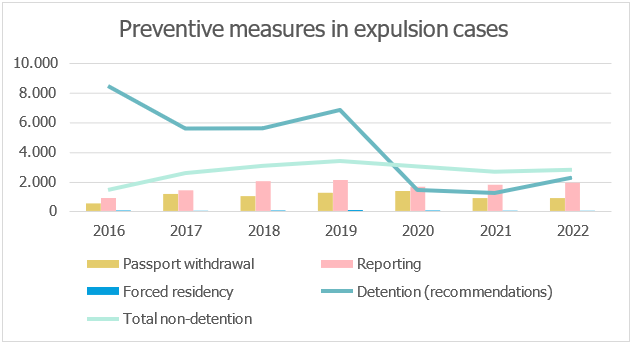
Yet, we also observe a significant downward trend in the use of detentions, even after the pandemic the numbers remain far below pre-2019. There are several causes behind this drop in the use of detention. The closure of detention centres and the reduction of deportation flights due to COVID-19, significantly lowered the number of detentions authorised and brought an increase in the use of some of the non-detention measures, particularly passport withdrawal. At the same time, the capacity of detention centres was reduced due to the works to improve living conditions within them, which partially explains why the numbers have not raised again. Finally, according to recent data by the Ministerio de Trabajo, Seguridad Social y Migraciones, since 2019 there has been a significant reduction in the number of years spent in irregularity by those that obtain a residence permit through the figure of arraigo, which leads to the possibility that there would be a lower number of people living without status.
In comparison, individually, non-detention measures are less used than detention. If aggregated, however, while non-detention measures where scarcely used before 2017, they show an upward tendency until 2019 and a stagnation after that. Yet, ethnographic data suggest that, due to the fact that non-detention measures can be implemented without the authorisation of a judge, poor record keeping of non-detention measures could be misrepresenting how often these are used.
These preliminary results point at a potentially effective use of non-detention measures as a widespread practice. That is, although detention should be a last resort, in the practice it is still the most frequently employed measure. However, this does not imply that alternatives are either unavailable or ineffective. On the contrary, as demonstrated during the COVID-19 pandemic, when detention centres were closed, alternative measures were successfully implemented. This highlights the potential to shift from the use of detention. These viable alternatives offer a more dignified solution for people in expulsion processes and are potentially more cost-efficient for governments.

